Posts

Showing posts with the label Balian d'Ibelin II.

Balian II: Lord of Beirut

Image
Balian, the Lord of Beirut’s eldest son and heir, was the head of the Ibelin family in the fourth generation of the House.  He was a grandson of that Balian d’Ibelin who defended Jerusalem against Saladin in 1187, and the eldest son and heir of the leader of the baronial opposition to Frederick II, the “Old Lord” of Beirut. Yet according to his close friend and “compeer” Philip de Novare, he was a man of decidedly different temperament and personality from his more famous forefathers. Today I conclude my biographical sketch of Balian d’Ibelin II.   Philip de Novare tells us that when making his testament, the “Old Lord” of Beirut “gave many fiefs to his children and ordered that they should hold them of their eldest brother and be his vassals.” [i] In short, Balian was to the senior and greatest beneficiary of his father’s estate.   Clearly, Balian had been fully forgiven of any transgressions against his father. He assumed the leadership of the family. Yet we should ...
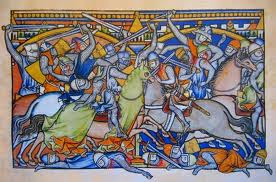
The Battle of Nicosia - July 14, 1229

Image
  In 1229, the rapaciousness of the Emperor’s baillies provoked a response they apparently had not anticipated. In less than three months, they were facing not resistance or insurgency but a full-scale challenge to their authority in the shape of an invasion. Whereas, with their mercenaries, they had held a monopoly on force of arms up to this point, in early July 1229 they were confronted by an army led by two barons with hundreds of knights.   In the most comprehensive modern history of the Kingdom of Cyprus, Prof. Peter Edbury writes that “spurred on by the news of the sequestration of their fiefs and plight of their womenfolk,” [i] a force of men raised by the Lord of Beirut set sail from Acre and landed at the Templar fort of Gastria to the north of Famagusta. The size of that force is unrecorded, but it must have included several hundred knights. The Five Ballies Frederich II had left in control of Cyprus (See: The Emperor’s Men) controlled not only the feudal re...